Wednesday, April 27, 2016

A Parent's Guide to Disney's Mulan


            Young children may be frightened of the Huns, the villains of the film. They’re evil and fairly grotesque looking. The film does a good job of making them convincingly villainous. They are always accompanied with ominous music and dark colors, so children should easily understand that they’re the bad guys. If your children are scared by the Huns and their scary nature, just try and assure them that they are not real and cannot hurt them, as young children often have trouble understanding the reality and fantasy of media.

            Mulan’s friends and the other heroes stand in contrast to the Huns. All of them, her dragon sidekick Mushu specifically, are fun and silly. They represent a change of pace from the serious and grave nature of the Huns, and children should really enjoy their antics. In addition to entertainment value, this juxtaposition to the Huns helps avoid any confusion as to who the children should root for. As far as Mulan goes, she is a convincing and enjoyable hero. Her journey is emotional and rewarding for children and adults alike. Though young children may not understand all of the underlying themes and elements of her struggles, such as living in a strict patriarchal society and not feeling as though one has a place in the world, they will be able to understand that she is sad in the beginning of the film and gains happiness through her achievements.   

           Due to the polarity of the gender norms presented in Mulan, children most likely won’t have any trouble identifying male and female characters, what their roles are, and what they’re “supposed to do.” Instead, children under the age of seven may have a hard time discerning whether or not these gender roles are accurate reflections of their own life and the society at large. The ultimate goal of a woman in the film is to work toward acting favorably in a manner that will get her a man. If a woman doesn’t accomplish this, she is seen as dishonorable to her family and therefore worthless. If a child, regardless of biological sex or gender, sees the film without any idea of how the real world operates, they may begin to believe that women are supposed to be all of the things that the film celebrates as being “a real woman.” Although they may pick up on the fact that Mulan is an intelligent, strong, brave young woman, the more preferred gender roles in the film's society are the ones that are emphasized.


       Male body image and expectations are also presented in a dichotomous nature. Take Li Shang for example. As the captain of the division Mulan fights in he is required by the nature of the job to be physically and mentally strong, brave, and fierce. He exerts his physical strength and dominance throughout the film, which highlights the benefits of looking and behaving as he does. Li Shang can be seen as the physical manifestation of everything considered manly and masculine in Western society. His rippling muscles and professional success make him a desirable yet toxic model for young children. Much like with female representations in the film, Li Shang creates an unrealistic expectation for how boys and men should act around each other, toward women, and gives them aggressive goals to try and attain.
       

 In contrast to the success and fit nature of Li Shang’s character, the weak characters are often shown as being either extremely thin and bony or heavier and uncoordinated. There are no middle ground body types in the film. Either a man is thin or fat and weak or muscular and successful. This could also contribute to a negative idea of what men should be like for children, especially those in the process of developing their ideas about gender and the roles that accompany them.
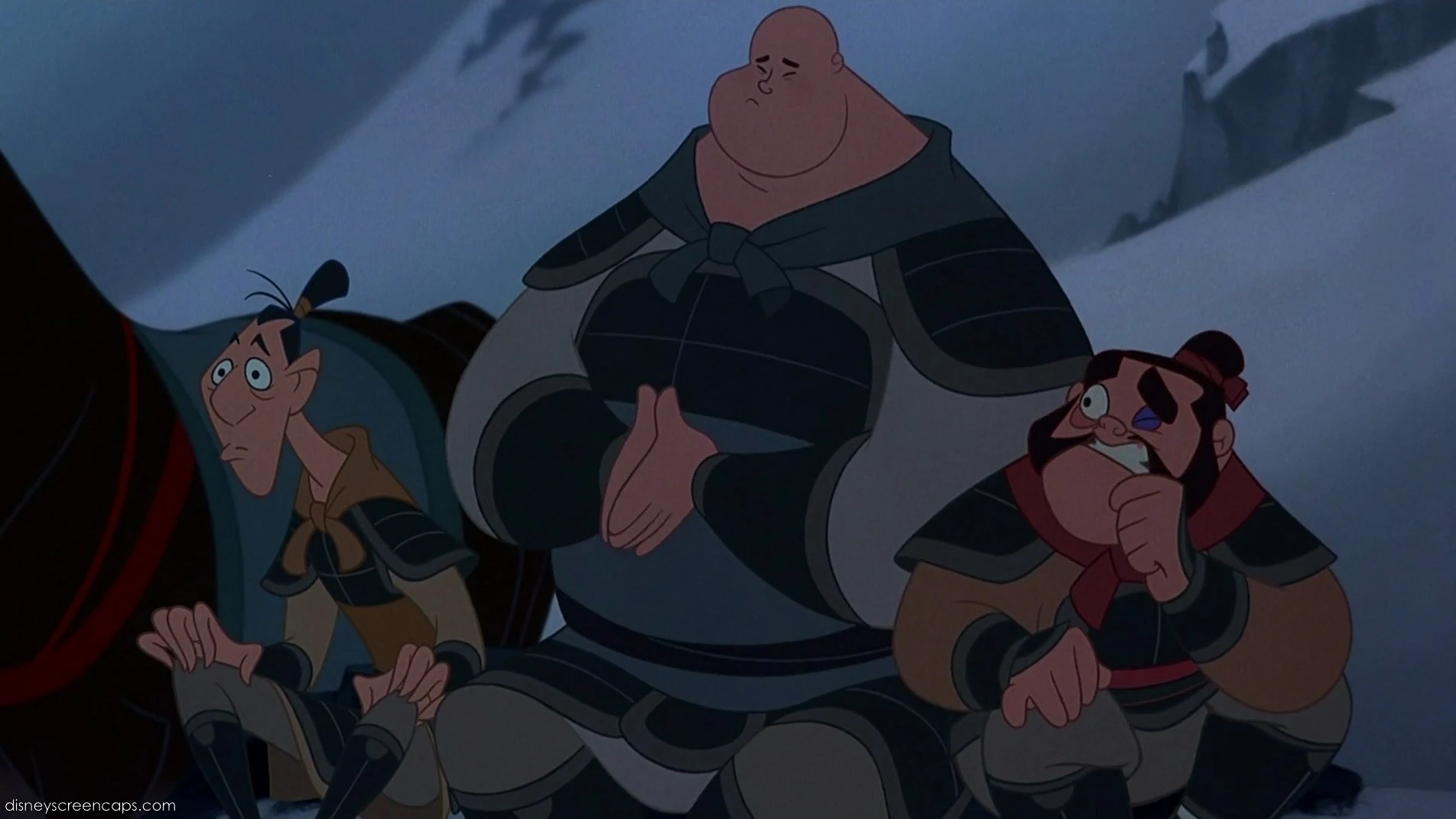

                 In order to diminish the effects of these binary roles on children while they watch the film, it is recommended that parents watch the film with their children and discuss the gender roles presented as they appear.  Explaining to children that one's gender doesn't dictate their worth and promoting healthy emotional expression can facilitate early emotional education. In addition, having a parent express immediate discontent with a problematic component of the film is the best way for a child to learn what is or what is not appropriate. Since children have limited memory capacity, sitting down with a child after a film has ended will not be as beneficial because there is a high chance they have already forgotten the specifics of the scenes or events in question.


Due to Mulan being a story about a young woman in war, it is obvious that you are going to be exposed to countless scenes that involve violence. As a parent you may find the fantasy and sanitized violence in a cartoon film to be harmless, however a child may interpret what they are seeing much differently. Their lack of real world experience is going to give them a different developmental perspective on certain scenes in this film. 

In the start of one specific scene, the viewer is given a high energy and comical performance about each soldier’s perfect women and how they are fighting for these ideal women. They then abruptly stop singing and you are shown a piercing red and black devastated, scorched village left over from the Huns. As the scene continues on it shows a wide-screen shot of a field covered in black dots, ultimately representing the bodies of fallen soldiers. Although the characters don't discuss the sight they're seeing, their sad demeanor portrays to children that what has happened is not positive. As their journey continues, Mulan and her fellow soldiers are attacked in the snowy mountains. During the brawl Mulan is sliced by the enemy’s sword and pulls her hand away to find blood. A child could understand that Mulan is hurt but may not understand the damage a sword could do to an individual. As a parent, sitting with your child and partaking in social co-viewing would be beneficial to help a child understand these powerful scenes. Explaining that violence in the real world and violence in cartoons is different can help them understand that the film's messages about violence aren't realistic or acceptable.

The Parent Trap

The Parent Trap is Disney’s remake of the 1961 classic.  This 1998 adaptation has the same story line.  These identical twins, Hallie and Annie, were separated at birth each raised by one of their biological parent.  Their mom a very successful wedding dress designer live in London with her Annie, her father, and their butler, Martin.  While their father Nick Parker, a wealthy owner of his owner winery, lives in Napa Valley, California with Hallie and their maid Jessie.  They discover each other at a summer camp, and decide they will switch places to meet the other parent.  When Annie arrives in California, much to her dismay, she is greeted at home by her father's new girlfriend, Meredith.  Ultimately this story is a romantic drama/comedy about true love and the strong need for children to be with their parents.  It is rated PG, but has been a classic that has entertained families for many generations. 
            
There are some scenes that should be watched by children with an adult close by to explain what is happen to their children.  Young children have difficulty processing the differences between fantasy and reality, especially when it come to the notion of divorce.  Unfortunately, divorce is a very realistic part of many families today, and this movie displays a very unlikely and fanciful story about divorce.  Deceit is a big theme throughout the film, from their parents lying for the first eleven years of their lives about their biological sister to the false hope that if children try hard enough you can bring your parents back together and live happily ever after.  Even Meredith being portrayed as the evil, gold-digging step mother can scare young children, when in actuality the parent may be happier with a new spouse.  Considering the prevalence of divorce, a child understanding the normalities of divorce vs the mythical aspects of divorce portrayed in The Parent Trap is essential to assure that the child does not have any false expectations, negative stigmas, or unrealistic hopes when coping with their own parent’s divorce or about the divorce between people that they know.  
The references and uses of alcohol throughout the movie is very prevalent.  Parents will definitely want to be present and discuss this with their young children.  Children are constantly being exposed to alcohol in all different types of media.  The Parent Trap shows Hallie at eleven and half years old being allowed to try wine at the dinner table.  This action has the ability to reinforce in a child’s mind that alcohol is ok, when in actuality it can have very deterimaental effects on kid’s minds and behavior.    Alcohol consumption in a later scene is presented in a harmless, silly light and again shows no consequence for consuming it.  Elizabeth believes she is not mature enough to see her ex-husband for the first time in almost eleven years, and is more than tipsy when she arrives to the hotel where her ex husband is.  For many adolescents talking to a crush may be difficult, this scene shows that alcohol can help to soften the awkwardness of situations of that nature.  Alcohol suppresses your nervous system and makes you have less fear and anxiety.  These behaviors engaging in alcohol are extremely risky.  Young children definitely look up to the characters in the film as role models, but this is not a good model for a child to try to emulate. By altering an adolescent’s environmental characteristics via coviewing with family members, the movie or at least these particular scenes involving alcohol/underage drinking could be explained and/or guided through by an adult.
Bullying was also a common theme shown throughouot the movie.  Whether it was the twins bullying and pranking each other at camp before they knew about their common identity, or it was the twins bullying Meredith on their annual summer camping trip.  Their pranks while ultimately harmless, demonstrated how girl cliques can bully to show who is more dominant, popular, and better than the next.  The bullying Hallie and Annie put Meredith through was wrong and disrespectful, pulling her mattress into the lake while she is fast asleep on it, and can give children a false sense of hope that they can act the same way towards their mother or father’s significant other and get the same result of splitting them up. Television and movies have the ability to cultivate one’s perceptions of social reality.  Through this cultivation, young children can and do try to alter their view of reality to match what they see on the screen. 
            
Ultimately it is a movie that familys of all different backgrounds and ages can enjoy.  Love, family, friendship are all very prominent themes throughout the movie.  The positive themes most definitely outweigh and outshine the negative themes.  Compared to other Disney films, there is not much violence or visually disruptive characters.  The characters visually looking inviting and approachable, which help the audience want to see the family come back together.  If parents or adults are willing an able to sit with the children and explain certain scenes and references, it will definitely be a movie the whole family will appreciate and want to watch again!

https://www.youtube.com/watch?v=32WeiH4TrIY 

Tuesday, April 26, 2016

Finding Nemo


The Disney Pixar film, Finding Nemo portrays a strong father- son relationship tied with humorous scenes that will have you and your family laughing. Set in the deep, colorful ocean, this film captures the adventure of a young clownfish, Nemo, and his Father, Marlin as they tackle life underwater. Though Finding Nemo is rated G and is admitted for all ages, there are many scenes that could come across as scary and frightening for children under the age of 7. Along with fear reactions, young children will experience processing limitations to some of the content, effects of media violence, and emotional understanding while watching Finding Nemo.
The creatures and marine life in Finding Nemo will leave small children with a sense of fear towards the unknown. Even in the opening scene a hostile fish with piercing teeth aggressively attacks Coral and Marlin's baby eggs, and the fish are left noticeably hurt and unresponsive. Due to the cognitive development of children's imagination developing, the pure image of a terrifying fish along with the scary sound effect will naturally make a child feel frightened and uncomfortable. This could cause children being afraid to sleep at night, and they would benefit from a conversation and a parents point of view. Some other scenes including an encounter with the main shark Bruce involving blood, a scary deep voice, aggressive talking, frightful laugh, and eyes changing from normal to demon- like will activate young children's auditory and visual attention, along with their perceived appearance to reality, believing that what they see in Finding Nemo is real life.
The death of Nemo’s mother was one of many deaths in a variety of children’s movies that starts the main plot like most Pixar and Disney films. The way children perceive death in cartoon films depends on the cognitive development and age of the child. Children under the age of four pay attention to the perceptual representation that invoke fear reactions while children over four years of age can start to practice a conceptual process containing the gravity of death in children's films. From the age of early childhood to middle childhood, children change from concrete thinking to inferential thinking, so kids would be able to link different scenes in Finding Nemo like when Nemo was in his egg in the beginning and it was scratched to why he had a “lucky fin” or technically a disability which the film portrayed in a very light hearted accepting way.  
Emotional responses from Finding Nemo may vary based on the age of the child viewing the film. The first scene of the movie can set the stage for the children viewing it and it probably a good idea to watch this movie with your children incase they get scared or upset when they see this scene along with other scenes; like the jellyfish scene or the one with the pilot fish. Because children as young as 4 years old are able to identify and relate to facial expressions from characters they are seeing, they will be able to know through the expressive animated characters when they are upset, in fear, or happy. Since children at the age of 4 are able to recognize emotion it is important to realize when media is framing children and shaping social problems. While bullying and violence wasn’t a major theme of this movie there was the ideas of inclusion and fitting in that did play a role. After Nemo was kidnapped he was taken to a dentist office and placed in a fish tank, there he was not completely accepted at first but then eventually initiated into the “group” of fish that were already there. This scene does show inclusion and acceptance, but also does have some negative images of Parasocial images for children. Overall the emotional understanding and the violence in this film are not something that parents should be worried about, however for younger children it would be good to watch this movie with them and explain what exactly is going on.

Inside Out


Inside Out

By: Taylor Mills, Alex Valenta and Anne McAlister


In the summer of 2015 Disney Pixar released a new movie, Inside Out, that brings the audience’s emotions to life. Aimed towards kids and families, this is a story about an eleven-year old girl, named Riley, faced with some challenges of growing up. She learns how to deal with all of these big life changes through her different emotions. We meet the emotions inside Riley’s head such as Anger, Disgust, Fear, Sadness and Joy. The audience watches as each of these emotions are created and developed as Riley ages. As Riley grows up and makes memories, those memories are stored in colored orbs that are sent to long-term memory each night. Throughout the movie we watch as Riley struggles to deal with her more difficult emotions such as anger during this difficult time in her life. Inside Out is is used as an educational tool to help children to learn about their emotions however, it is difficult for the child to understand the implicit messages and the overall theme of the movie.
There are two separate storylines happening simultaneously in the movie. One in which Riley and her family move from the Midwest to San Francisco; and another in which Riley’s emotions try to guide her through this life-changing event.Younger children would have a tough time connecting the dots between the two plotlines because they are at a lower cognitive developmental stage than older children. This is a concept known as centration in which children are only able to focus on a single striking feature. Young children will have a difficult time understanding that the two plotlines are intertwined and influencing each other. This Pixar movie is focused around an individual’s development of emotions from a young age into adolescence and the teen years. The movie showcases how the emotions are stuck in their ways and refuse to allow multiple emotions to be felt simultaneously. However, the audience learns at the end that the key to living a prosperous life with continuous self-growth is to allow one’s emotions to balance each other out and work together. The creators of Inside Out found a way to educate its audience by incorporating aspects of human processing, real life situations, and feelings into a funny and charming children’s movie. 
In conclusion, although it is an educational tool to help children to learn about their emotions, Inside Out is a difficult movie for children to understand when it comes to the implicit messages within the movie in addition to the overall theme of the movie. While it may be challenging for a young child to grasp the moral lesson, this movie has an overall positive tone and will have positive effects on a child. There are no instances of violence or inappropriate behavior, therefore, this movie is appropriate for all age ranges. Children may watch this movie without the guidance of an adult and will not be negatively affected by the content. This movie teaches children how to deal with their emotions by making each emotion; joy, sadness, fear, anger and disgust, come to life. Parents can play a major role in allowing children to learn from this movie. By watching this movie with their kids and engaging them in dialogue about the attitudes and behaviors of the characters, parents can help their children to learn adult concepts at a young age. This film’s lighthearted and goofy nature will be entertaining to children of all ages. Not only is this a movie for children to learn from, it is one that parents and adults can enjoy as well. Overall, the lessons learned from this movie will be beneficial to children of all ages and genders. Whether they have experienced similar distress or not, children will gain the capacity to deal with difficult situations in their future. The important takeaway from this movie is to not suppress any emotions and to allow the emotions to shape your future experiences. For example, the emotions in Headquarters were determined to not let Riley feel sadness, however, the audience understands by the end that sadness is what led Riley to greater relationships and happier memories. In creating Inside Out, Pixar touched upon the topic of emotions and dealing with real life experiences. This unique movie is a step in the right direction for a child to learn about life and themselves as well as the production industry to create motion pictures that are educational and entertaining for all.


Friday, April 22, 2016

Thursday, March 31, 2016

Growing up in pornland.....

Sexually explicit content is easier to access than ever before. It's quicker and more anonymous and easier to access extreme forms of content right from  your own phone.

Research demonstrates a number of negative effects of pornography on young people and adults, including belief in rape myths.

Another effect of such easy and frequent access to porn has to do with the sexual scripts developed by young people still forming their sexual identify. Does porn lead to unrealistic expectations about sexual relationships and about women more generally?

This article, based on a survey commissioned by Plan Australia, interviews girls and young women between the ages of 15 and 19 and also links porn consumption by young men to online sexual harassment.